 Pizyn
What launched, and when
The timeline is short. On November 16, 2026, Kling AI posted a "Coming Soon" teaser poster and a preview deck for Image 4.0, days after its video model Kling 4.0 had settled into general availability. On November 18, the official API documentation went live at klingai.com, together with a pricing page and release notes — and Kling's own site started showcasing Image 4.0 samples. We read the docs, the pricing page and the release notes the same day; every specification in this article comes from them.
Two clarifications first. This is not the Kling 4.0 video model. Kling 4.0 is the video-generation model, launched October 15, 2026 — it makes 3–30 second clips. Kling Image 4.0 is the still-image model of the same 4.0 generation: same branding, different model, different job.
The one external signal so far is a preview listing: LLMBoard lists a "Kling Image 4.0 (preview)" at #25 of 129 image models, score 63.07, updated November 17, 2026. That is a benchmark preview, not a test anyone can reproduce — and no independent third party has published Image 4.0 generations yet. Everything visual in this article is Kling's own material, and we say so under every image.
Specs at a glance
| Status | Official API live since November 18, 2026 (docs + pricing published); available on Pizyn since November 18, 2026 |
| Endpoint | POST api-beijing.klingai.com/image-generation/kling-4.0 — async: submit a task, then poll for results |
| Resolutions | 2K / 4K / 8K (default 2K); long images 1K / 2K |
| Images per run | 1–9 in single mode (default 1) |
| Series mode | 2–10 coherent images from one brief (or auto, default 4) |
| Reference images | Up to 10 reference images + saved subjects per task; JPG/PNG only, each ≥300px, ratio 2:5–5:2 |
| Aspect ratios | Auto + 16:9, 9:16, 1:1, 4:3, 3:4, 3:2, 2:3, 21:9 |
| Text rendering | Up to 2,000 characters per image, complex layouts; Chinese, English, Japanese, Korean, Spanish, Portuguese |
| Fonts | 70+ built-in commercial fonts, chosen via the prompt or a font reference image — no dedicated font parameter in the API |
| Long images | Native 1:12 via the long-image skill — short / medium / long, 1K or 2K, one image per task |
| Prompt length | Up to 15,000 tokens per the release notes |
Two things stand out in that table. First, the API is genuinely async — you submit a task and poll for results, with a 20-minute timeout after which a stuck task is released and must be resubmitted. Second, several headline features have no dedicated parameter: fonts, the 110+ preset tones, and HEX/RGB colour values are all handled through the prompt or reference images. That makes prompt wording do more work than in most image APIs.
What it costs
For context against the live flagships in this studio: Seedream 5.5 at 2K costs 6 credits, about $0.06 per image, and GPT Image 2.6 costs 9 credits, about $0.09. The studio price is live: Kling Image 4.0 on Pizyn costs 11 credits at 2K, 16 at 4K and 26 at 8K; image edits start from 11 credits. One billing detail is already good news: Kling does not charge when a task fails — the same pay-only-on-success rule this studio already applies.
What the official samples show
Every image below is Kling's own sample, picked by Kling to show the model at its best. That is the right way to read them: a ceiling, not an average. The honest read of each one — what it demonstrates, and where to look twice — follows.
Realism: a group shot that holds together
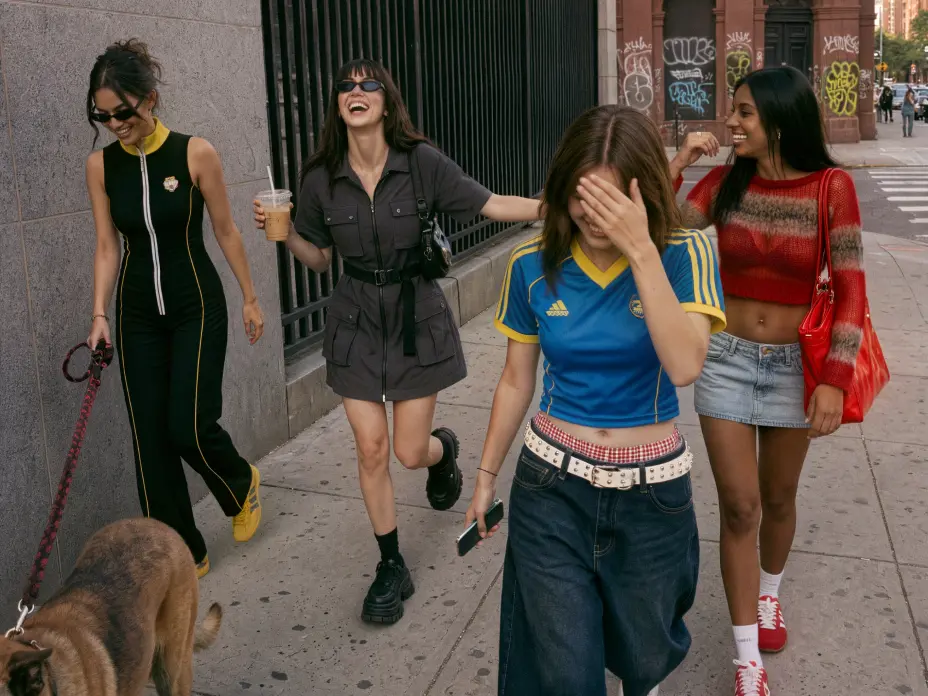
The hero image at the top of this article is the strongest realism claim in the set: four young women and a dog on a city street, laughing mid-stride. Group shots are a known weak point for image models — faces drift, hands multiply, the fourth person comes out wrong — and this one holds together at a glance: four distinct faces, natural expressions, coherent street scene. Look twice and you can see where the difficulty went: one woman's hand covers her face, which hides the hardest case, and the dog is half-cropped at the frame edge. That is not a failure — it is a reminder that a chosen sample shows what the model can do, not what it does every time.
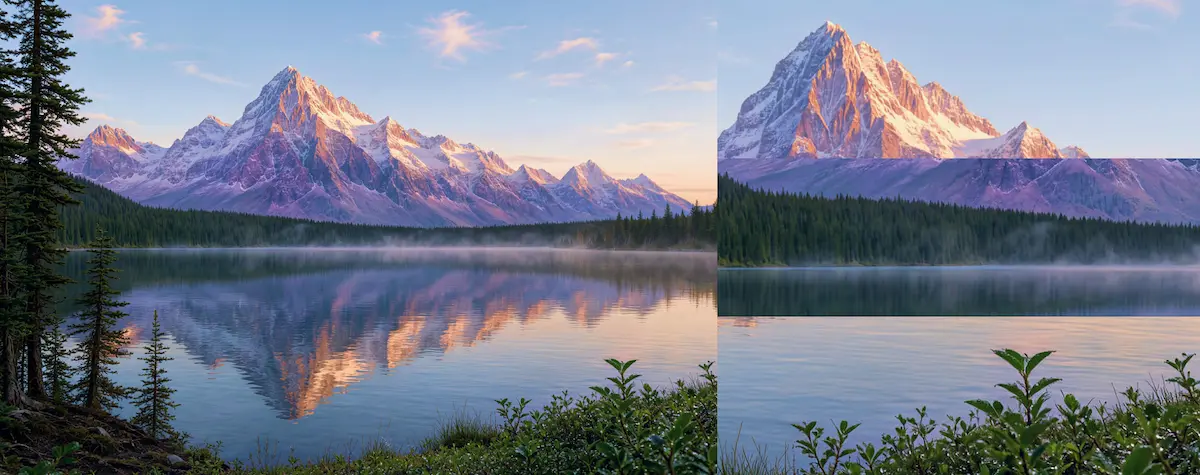
Official Kling sample — an 8K mountain landscape with detail close-ups. The zoom panels are the point: detail that survives a crop.
The 8K story is told the same way, with a landscape and its own detail close-ups: the mountain peak and the shoreline, magnified, still sharp. Detail that survives a crop is what 8K is for, whether the destination is a large print or a tight retouch. What the showcase cannot show is the full 8K file itself, so the native-resolution claim still awaits an independent check.
Text: a whole menu, prices and all
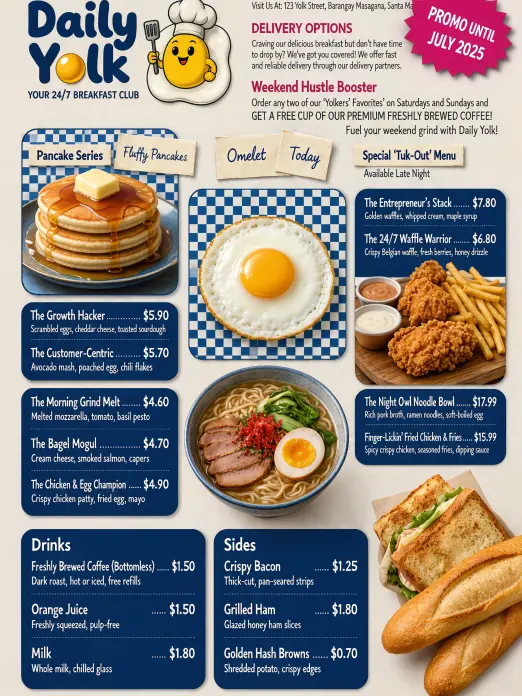
Official Kling sample — a full diner menu. Sections, dish names and prices are all legible; the promo badge says July 2025, a past date the model invented.
If one image sells the text claim, it is this diner menu: sections, dish names, descriptions, and prices — $5.90, $5.50, $4.60 — all legible and internally consistent, with the layout holding together across a dense page. That is the 2,000-character promise in practice. But look at the corner badge: "PROMO UNTIL JULY 2025" — a past date, invented by the model — and the address line at the top is cut off mid-word. The text is accurate where it matters and sloppy where it doesn't, which is exactly the pattern to check before using generated text commercially: verify every number and date, not just the headline.
Long images: a full detail page in one generation
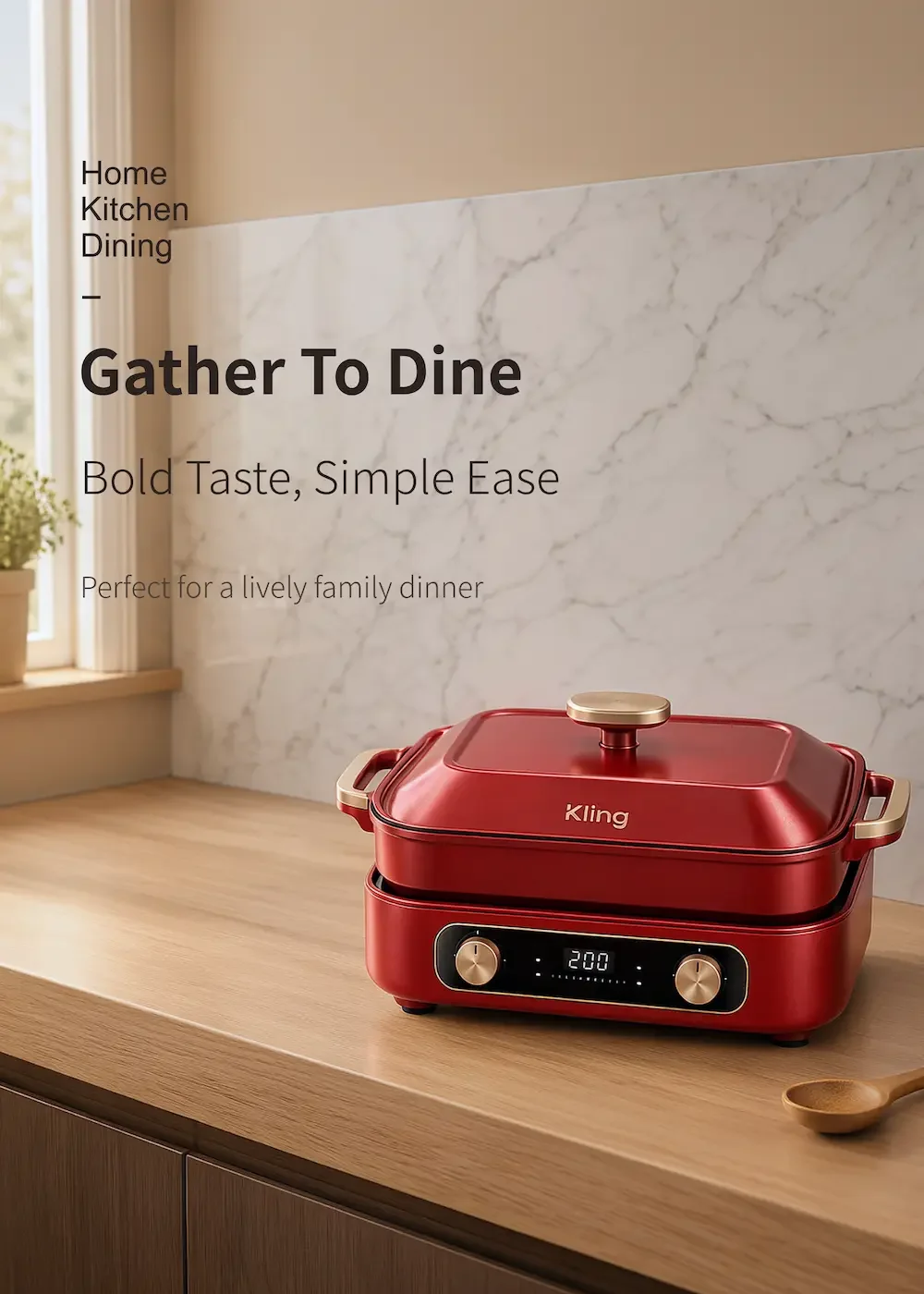
Official Kling sample, cropped preview of the full 1,000 × 13,640px page — the top section only; the full page continues through feature callouts and specifications.
The long-image sample is a 1,000 × 13,640px e-commerce detail page for a red electric hotpot — hero shot, headline ("Gather To Dine"), sub-lines and product render in the top section alone, with the page continuing through feature callouts below. One generation, no stitching: that is the 1:12 skill's whole pitch, and it is the format most image models simply cannot produce. Kling's release notes add that long images come out layered, so individual elements can be edited and re-generated afterwards — a claim no third party has tested yet. The crop above is the top 1,400px of a page thirteen times taller than it is wide.
Series: one character, nine frames
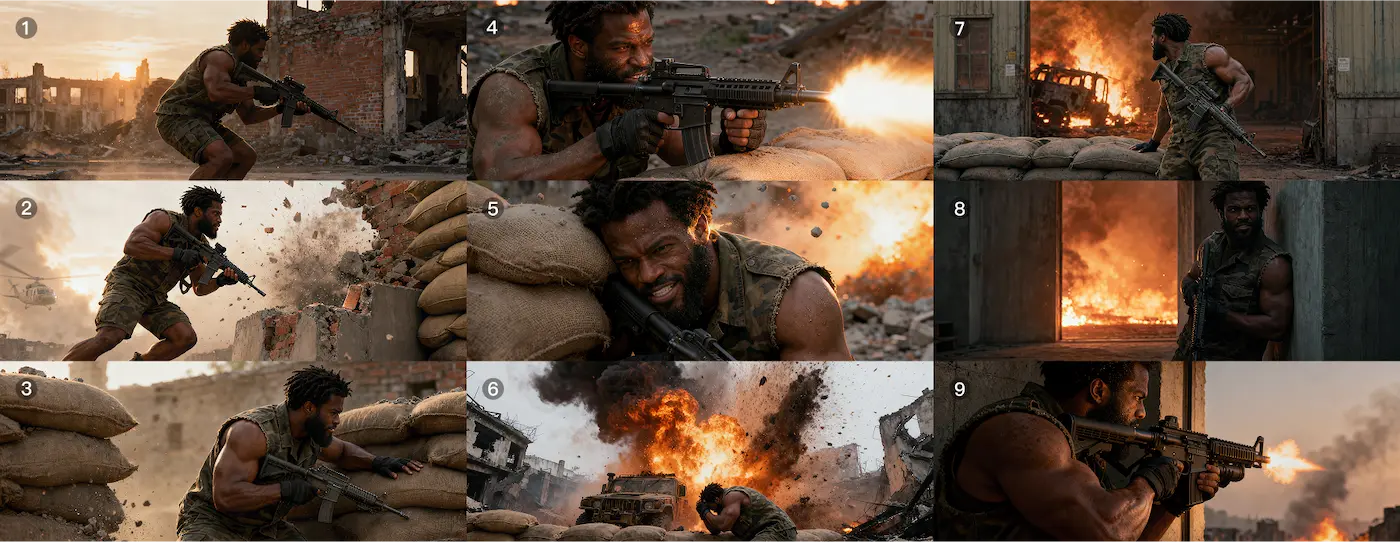
Official Kling sample — a nine-frame series. Same soldier, same kit, across nine numbered frames: the coherence claim, in one image.
The series sample is the most ambitious of the set: nine numbered frames, one soldier, one continuous combat sequence in industrial ruins at dusk. The face, the build, the kit and the lighting stay consistent across angles and distances — that is what series mode is for, and it is the hardest consistency problem after multi-reference character work. It is also the sample most in need of an independent re-run: series mode is new, nine coherent frames is a strong claim, and Kling chose the sequence.
What's still unproven
No independent tests exist. As of November 18, 2026, nobody outside Kling has published Image 4.0 generations with prompts, settings and verdicts — the LLMBoard preview is a benchmark listing, not a test. Text accuracy at scale is unverified. The menu is one chosen page; 2,000 characters per image is a docs claim, and real-world accuracy across languages, fonts and layouts is still to be measured. 8K is native per Kling. The docs list it as a resolution tier, not an upscale — but no independent tester has inspected a full 8K output yet. Long-image layering is a release-notes claim only. Editable layers after generation would be a genuine differentiator for detail pages; until someone tries it, it is a line in a document. Failure modes are unknown. Every model has them — hands, counts, invented text, spatial relations — and Image 4.0's have not been mapped by anyone outside Kling.
Available on Pizyn now
It is live in the studio today. Kling Image 4.0 on Pizyn runs text-to-image and image edits at 2K, 4K and native 8K, with up to 10 reference images — 11 credits at 2K, 16 at 4K, 26 at 8K, and edits from 11 credits. The price is printed on the Generate button before anyone can spend one, and the pay-only-on-success rule applies: a failed generation costs nothing. Image sets and long images need their own controls and are not in the studio yet.
The useful preparation is still prompt work. The prompts, references and wording you build today carry over unchanged: draft poster briefs with the exact text in quotes and short — accurate in-image text is Image 4.0's headline pitch, and short quoted strings are what models render best — then run them straight through the studio.
Bottom line
Kling Image 4.0 arrived as a documented API faster than most flagships do — teaser on November 16, full docs and pricing on November 18 — and the docs describe a genuinely distinctive model: native 8K, 2,000-character text in six languages, 1:12 long images, and series of up to ten coherent frames, at official prices that sit beside the cheapest flagships in this studio. The samples back the shape of those claims, with the usual caveat that they are Kling's own picks. What is missing is the part no vendor can supply: independent tests and real-world failure modes. Both are being watched — and the model is already live in this studio, at 11 credits per 2K image.